
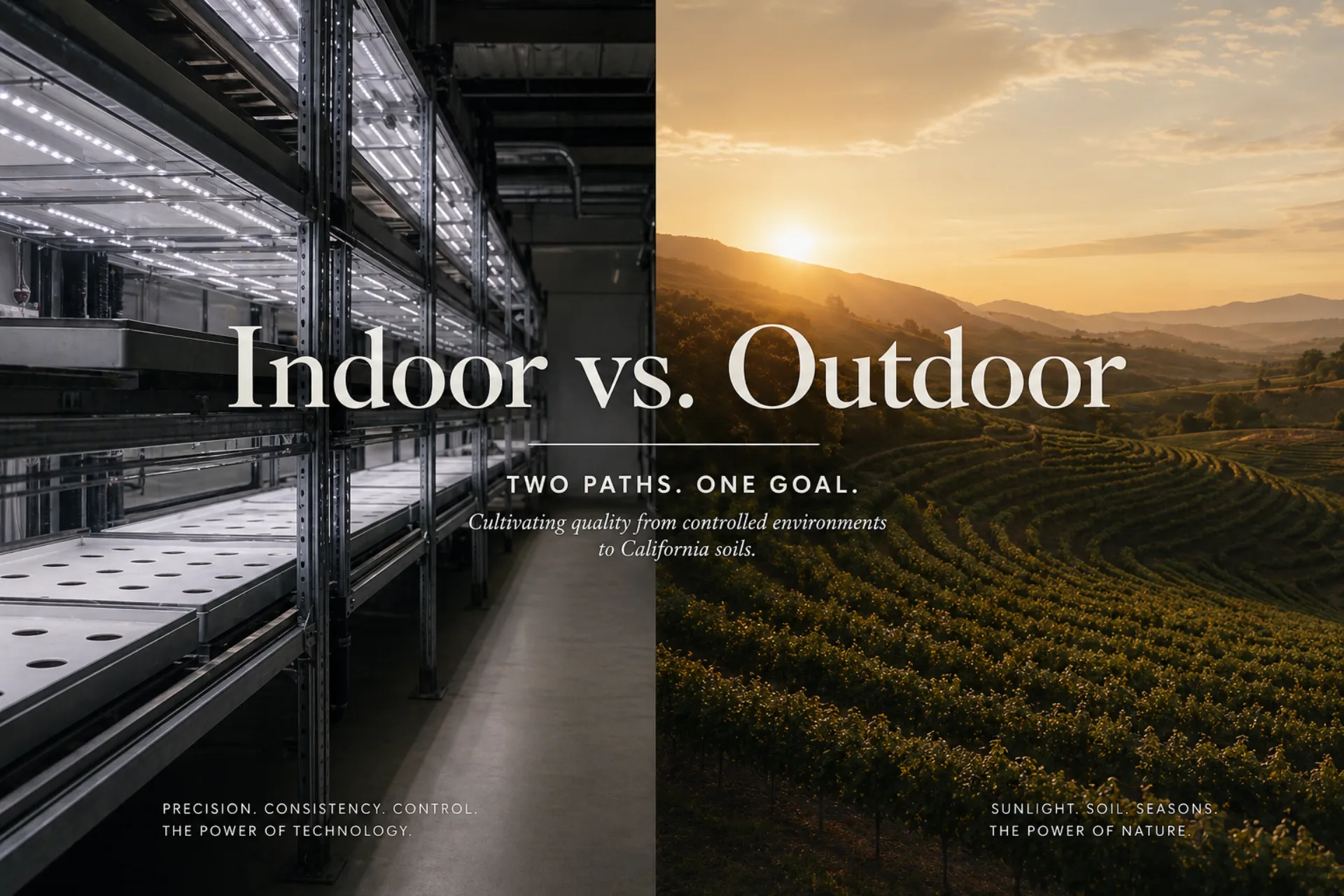
Ask ten craft growers where hemp "really" grows best and you will get ten confident answers, most of which disagree. The honest answer is that cultivation choices are a trade-off matrix, not a verdict. Indoor cultivation offers control over every input at the cost of energy intensity. Outdoor cultivation offers natural sunlight and a lower environmental footprint at the cost of exposure to weather, pests, and seasonal constraint. Greenhouse and light-assisted outdoor operations sit somewhere in the middle.
This essay is less about picking a winner and more about laying out the variables so you can read a producer's claims carefully.
Light
The single most consequential input for a hemp plant is light, specifically photosynthetically active radiation (PAR) in the 400-700 nanometer range. Outdoors in a California summer, peak PAR at solar noon can exceed 2,000 micromoles per square meter per second. Indoor operations using modern LED arrays target steady values in the 900-1,400 range for flowering, depending on the cultivar and the grower's philosophy.
The numbers matter less than the rhythm. Outdoor plants experience a light cycle that naturally shortens as summer passes into fall, which is the trigger for flowering in photoperiodic varieties. Indoor operations simulate that trigger by flipping lights from 18 hours on to 12 hours on at a chosen date, compressing the seasonal cue into a production schedule. Autoflowering varieties, which flower on a time-based rather than a light-based trigger, sidestep this entirely.
Soil and substrate
Outdoor cultivation is almost always in-ground or in large amended beds. The root system has room to develop broadly; the microbial community in the surrounding soil becomes part of the plant's input stream. Terroir, in the sense the wine industry uses it, is a real phenomenon in outdoor hemp: the cannabinoid and terpene profiles of a given cultivar grown in two different soils, in two different climates, will vary measurably.
Indoor operations typically use inert or semi-inert media — coco coir, rockwool, hydroponic reservoirs — and engineer the nutrient profile directly. This offers tight control and reproducibility, at the cost of the complex soil chemistry that outdoor growers rely on. Some indoor operations use living soil in large beds to try to capture the best of both worlds; these are typically smaller, craft-scale operations because the practice scales poorly.
Water
Water usage is an area where indoor cultivation has a surprising advantage on paper. Closed-loop hydroponic systems can run at water-use efficiencies that outdoor cultivation simply cannot match, because most outdoor water is lost to evaporation and infiltration rather than consumed by the plant. Whether that efficiency translates into a net environmental win depends on where the energy to run the indoor operation comes from, which brings us to the hard trade-off.
Energy
An indoor cultivation facility is, in energy terms, a chemistry problem wearing the costume of a farm. Lights, climate control, dehumidification, and ventilation add up to a per-kilogram energy footprint that peer-reviewed analyses have estimated at multiple megawatt-hours per kilogram of dried flower, with wide variation by facility and geography.
Outdoor cultivation uses sunlight, which has an energy cost of approximately zero at the point of use. It also uses far less HVAC and dehumidification, because the environment does the regulation for you. The catch is that you get one harvest per year in most climates, you are exposed to weather events, and you have limited recourse if a regional heat wave or an unexpected frost arrives at the wrong phase of the cycle.
The energy story is the cleanest argument for greenhouse and mixed-light operations, which use the sun when it's available and supplement when it isn't.
Pest pressure
Indoor cultivation is not pest-free — broad mites, spider mites, and thrips can colonize indoor grows and, once established, are difficult to evict. But the kinds of pests that threaten outdoor crops, from caterpillars to mammals, are largely absent. The offsetting concern is pathogen pressure: the warm, humid conditions that plants love are also conditions that fungal and bacterial diseases love. Indoor botrytis outbreaks can destroy rooms quickly if humidity control fails.
Outdoor growers deal with a wider variety of pressures but have more natural allies: beneficial insects, birds, and the simple fact that most pest pressures have a seasonal window. Integrated pest management works in both settings; it looks different.
The product differences
A few generalizations that hold up more often than they don't:
- Indoor tends toward tighter, denser flower structure; higher apparent cannabinoid concentration (because the plants aren't diluted by size); and a cleaner visual finish. The trade-off is sometimes a narrower terpene expression, because the environment is less varied.
- Outdoor tends toward looser flower structure, more seasonal variation within a given cultivar, and — in well-sited regions — distinctive terpene profiles that reflect the soil and climate. Lower apparent cannabinoid percentages often reflect better-hydrated, larger calyxes rather than less chemistry.
- Greenhouse and mixed-light operations can genuinely split the difference, especially in places with mild winters and long growing seasons. The best greenhouse product is difficult to distinguish from good indoor. The worst is difficult to distinguish from mediocre outdoor.
How we read a producer's claims
When a grower describes their cultivation practice, the things we pay attention to are boring on purpose: Is the facility certified or inspected by a third party? Does the producer publish their water and energy practices? How do they handle integrated pest management and, specifically, what is their policy on systemic pesticides? Can they name their cultivars precisely, or do they use vague marketing names? Do they publish lab reports with each batch?
A marketing page that emphasizes "premium" and "exotic" without answering any of those questions is telling you that the things they can measure are not the things they want to talk about. The opposite of that — a producer who can answer dull operational questions in detail — is usually a producer worth trusting.
Our next essay on lab testing and transparency picks up the thread on the documentation side.